


Readings to accompany America’s Violent Birth, the July 17 episode of The World in Time.
From
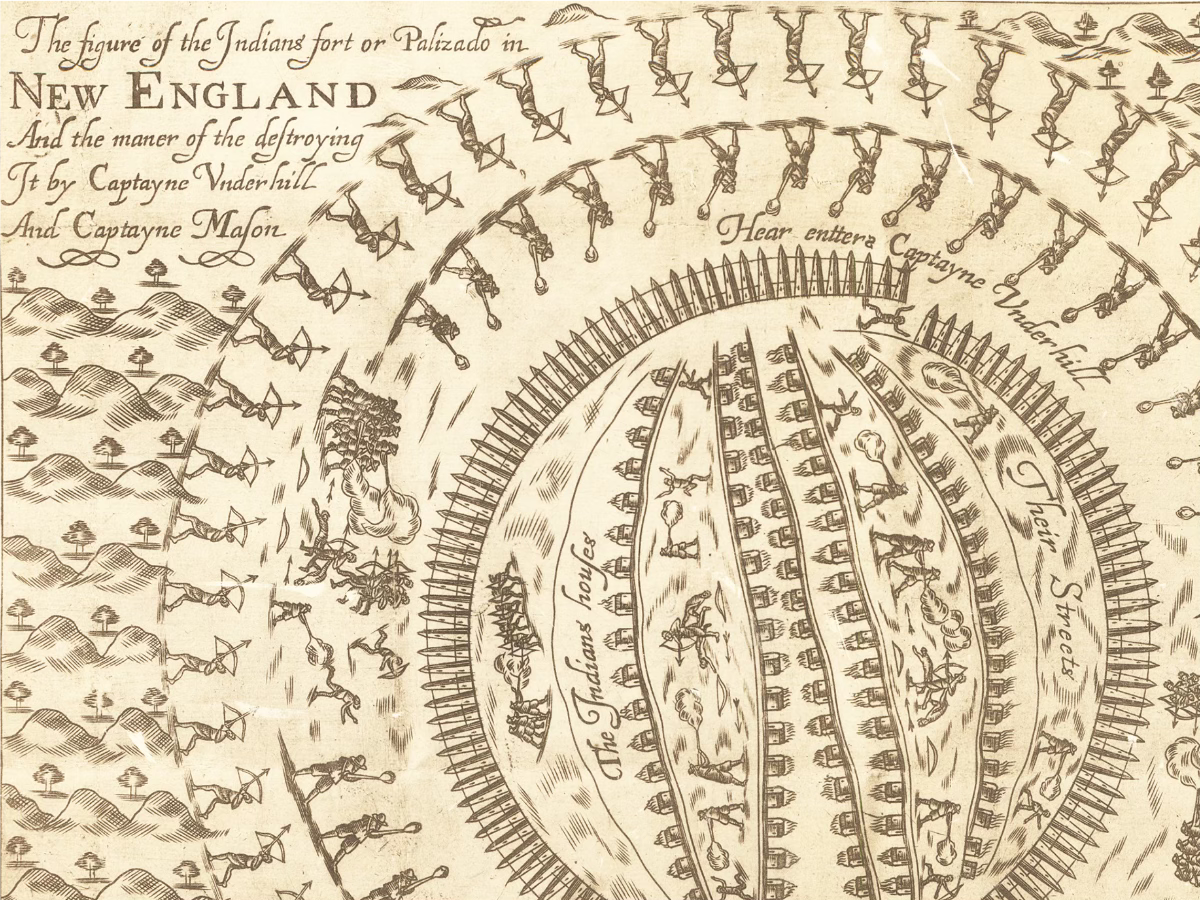
The Mystic River Massacre
How John Winthrop’s “city upon a hill” descended into the cataclysm of the Anglo–Pequot war.
By Peter C. Mancall
In the spring of 1634, smallpox spread across southern New England. It began, reported William Bradford, governor of Plymouth, near a trading house. The afflicted, Bradford wrote, “died most miserably; for a sorer disease cannot befall them, they fear it more than the plague.” The characteristic symptom was the eruption of small lesions on the skin. Bradford observed that those who had the pox “have them in abundance; and for want of bedding and linen, and other helps, they fall into a lamentable condition, as they lie on their hard mats, the pox breaking and mattering, and running one into another; their skin cleaving (by reason thereof) to the mats they lie on.” He claimed that just by rolling over, a victim might lose all of the skin on one side of their body. “And then being very sore,” he added, “what with cold, and other distempers, they die like rotten sheep.”
Normally, Indigenous communities had individuals who stepped in to heal the ill. Europeans might have doubted the efficacy of Indigenous cures, taking them for heathen devotions to dark forces. But even in their skepticism colonists knew that members of a native town tended to rally around to cure someone who was sick. In 1634, the normal practices fractured. There were not enough healthy Indigenous people available to bring water to the sick, maintain fires, or bury the dead. Unable to gather new firewood, native peoples, Bradford wrote, would eventually “burn the wooden trays, and dishes they ate their meat in, and their very bows and arrows.”
Some were so weak they could not make it back to their houses after having crawled out to find water. Bradford claimed that the colonists, after getting over their initial fear, “seeing their woeful, and sad condition, and hearing their pitiful cries, and lamentations,” felt enough compassion that they brought firewood, food, and water, and buried the dead. Even still, a local sachem and almost everyone in the town died. “But by the marvelous goodness and providence of God,” Bradford wrote, employing the characteristic rhetoric of dissenters who believed in predestination, “not one of the English was so much as sick, or in the least measure tainted with this disease,” even though they visited the Indigenous daily.
During the 1630s, infectious diseases killed thousands in North America, territory that, with the notable exception of the epidemic in coastal New England from 1616 to 1619, had been spared the kinds of catastrophic epidemics of hemorrhagic fevers that had taken the lives of millions in New Spain the previous century. But no more. The increased volume of shipping across the Atlantic amplified the chances that contagious individuals might land in North America, enhancing the possibility of Old World diseases killing individuals whose bodies may have already been weakened by stress induced by physical displacement and relentless attacks on their culture and beliefs.
At the same time, the number of colonists increased dramatically, especially in territory claimed by the Massachusetts Bay Company. The opposite demographic profiles of shrinking native towns and growing immigrant communities contributed to rising tensions in eastern New England. The tensions erupted in the cataclysmic Anglo–Pequot War of 1637.
Read the rest of “The Mystic River Massacre.”
CONTRIBUTOR
Distinguished professor of history at the University of Southern California, Peter C. Mancall is the author of eight books including The Trials of Thomas Morton: An Anglican Lawyer, His Puritan Foes, and the Battle for a New England; Nature and Culture in the Early Modern Atlantic; Fatal Journey: The Final Expedition of Henry Hudson: A Tale of Mutiny and Murder in the Arctic; and Contested Continent: The Struggle for North America, c. 1000-1680, volume one of the Oxford History of the United States.
Against the Hobbesian idea of the social contract in which “every individual concludes an agreement with the strictly secular authorities to insure his safety”—what Arendt calls the “vertical version of the social contract”—she argues that the American political experiment was founded on the discovery of a “horizontal” version of consent.
Horizontal consent has its roots in the “prerevolutionary experience” of early colonial Americans. That experience is marked by “numerous covenants and agreements, from the Mayflower Compact to the establishment of the thirteen colonies.” Signed in 1620 aboard the Mayflower, anchored off the coast of present-day Massachusetts, the Mayflower Compact was a declaration of self-rule agreed to by the Pilgrims and the commoners who had sailed with them. These future citizens from all social and economic classes arrogated to themselves the right to govern themselves, demanding that their government be one of consent.
Arendt expresses amazement at the astounding confidence these original settlers “had in their own power, granted and confirmed by no one and as yet unsupported by any means of violence, to combine themselves together into a ‘civil Body Politick.’ ” This new body politic was to be held together not by force, but simply by the faith each person had in the loyalty of each to their mutual promises. It was this actual experience of their joining together and constituting new governments—something repeated in every colony and in towns and cities across the North American continent—that, Arendt argues, was new and distinctly American. The American republic “rests on the power of the people.”
The power to covenant existed prior to America. But the generative idea of power through mutual promises and compacts was most often fleeting; it may have flared into existence, but it was quickly and consistently extinguished as new centers of power claimed for themselves the sovereignty and the right to govern. But this is not what happened in the American Revolution, at least in the first 150 years of the republic, where the “new American experience and the new American concept of power” was elevated and incorporated into constitutions and institutions “designed explicitly to preserve it.” In On Revolution, in which Arendt examines horizontal consent at greater length, she argues that the experience of the freedom to act together in assemblies and mutual compacts opened the American colonists to a “new experience of power.” The colonists had a history of acting in concert—to build roads and places of worship, found communities, and govern themselves. It is the “great good fortune of the American Revolution,” she notes, that the colonies, prior to the Revolutionary War, “were organized in self-governing bodies.” When the American Revolution broke out and the authority of the English king was rejected, the American revolutionaries were not transported into anarchy. This is because the colonists were experienced with organized power in government bodies through constituent assemblies.
What so impresses Arendt is that, in the wake of the liberation from England, the American colonists immediately took to governing themselves in legislatures elected according to constitutional principles, “so that there existed no gap, no hiatus, hardly a breathing spell between the war of liberation, the fight for independence that was the condition for freedom, and the constitution of the new states.” Without missing a beat, the colonists made use of their experience in self-government to put new constitutions before the people of the various states for popular approval. Thus, the American constitutions were not simply acts of government designed to limit the government and protect civil liberties. Rather, the constitutions were active examples of a people coming together to constitute themselves.
The American constitutions were more about creating new powers than about limiting power, and it was this task, “the creation of new power,” that Arendt saw to be the central activity of the American Revolution. The difference between American constitutions and their European descendants is that in America the constitutions were not made and imposed by experts, but were constituted by the people themselves.
When Arendt published On Revolution in 1963, she worried that Americans had lost the foundation of their freedom and power, because the U.S. Constitution did not in the end institutionalize the public spaces of power that had given Americans the experience of freedom. There is no institutional space guaranteed by the Constitution for town hall meetings, citizen deliberation, or civic associations. Thomas Jefferson himself saw this problem and understood that while the Constitution “had given freedom to the people” it “had failed to provide a space where this freedom could be exercised.” For Arendt and for Jefferson, “the failure of the founders to incorporate the township and the town hall meeting into the Constitution” meant that representation came to supplant the experience of freedom in self-government: “‘the school of the people’ ”—Emerson’s phrase—“in political matters had withered away.” And since the “Constitution itself provided a public space only for the representatives of the people, and not for the people themselves,” the expected result was their increasing lethargy and “inattention to public business.” This failure to guarantee in the Constitution spaces of freedom for the people meant that the “treasure” of the American Revolution, the experience of freedom that underlay the foundation of freedom, was lost. Arendt’s conclusion in On Revolution is that the tragic loss of the revolutionary spirit of freedom was the result of a turn away from civic republicanism toward bourgeois consumption.
Read the rest of “The Right to Dissent.”
CONTRIBUTOR
Roger Berkowitz is Founder and Academic Director of the Hannah Arendt Center and Professor of Politics, Philosophy, and Human Rights at Bard College. His books include The Gift of Science: Leibniz and the Modern Legal Tradition and A World We Share: Hannah Arendt and the Power of Friendship in a Broken World, forthcoming from Yale University Press in October 2026. You can find him on Substack here.
From
Our Chief Danger
The story of the democratic movements that the framers of the U.S. Constitution feared and sought to suppress.
By William Hogeland
If the framers of the Constitution weren’t our founding democratic ancestors, and indeed created a Constitution designed to obstruct democracy, we can nonetheless find such ancestors among forces that the framers sought to shut down. The founding-era democratic movement, though obscure today, was strong. And it was just as American as its more famous opponents.


