

Voices: Botanical Illustrations
Andrea Wulf on George Forster’s breadfruit botany; Horace Gray on tomato taxonomy; Sarah Lohman on Edmond Albius' vanilla horticulture; Michael Pollan on poppy toxicology; why sailors fear bananas.

Readings to accompany “Andrea Wulf on George Forster,” the July 31 episode of The World in Time.
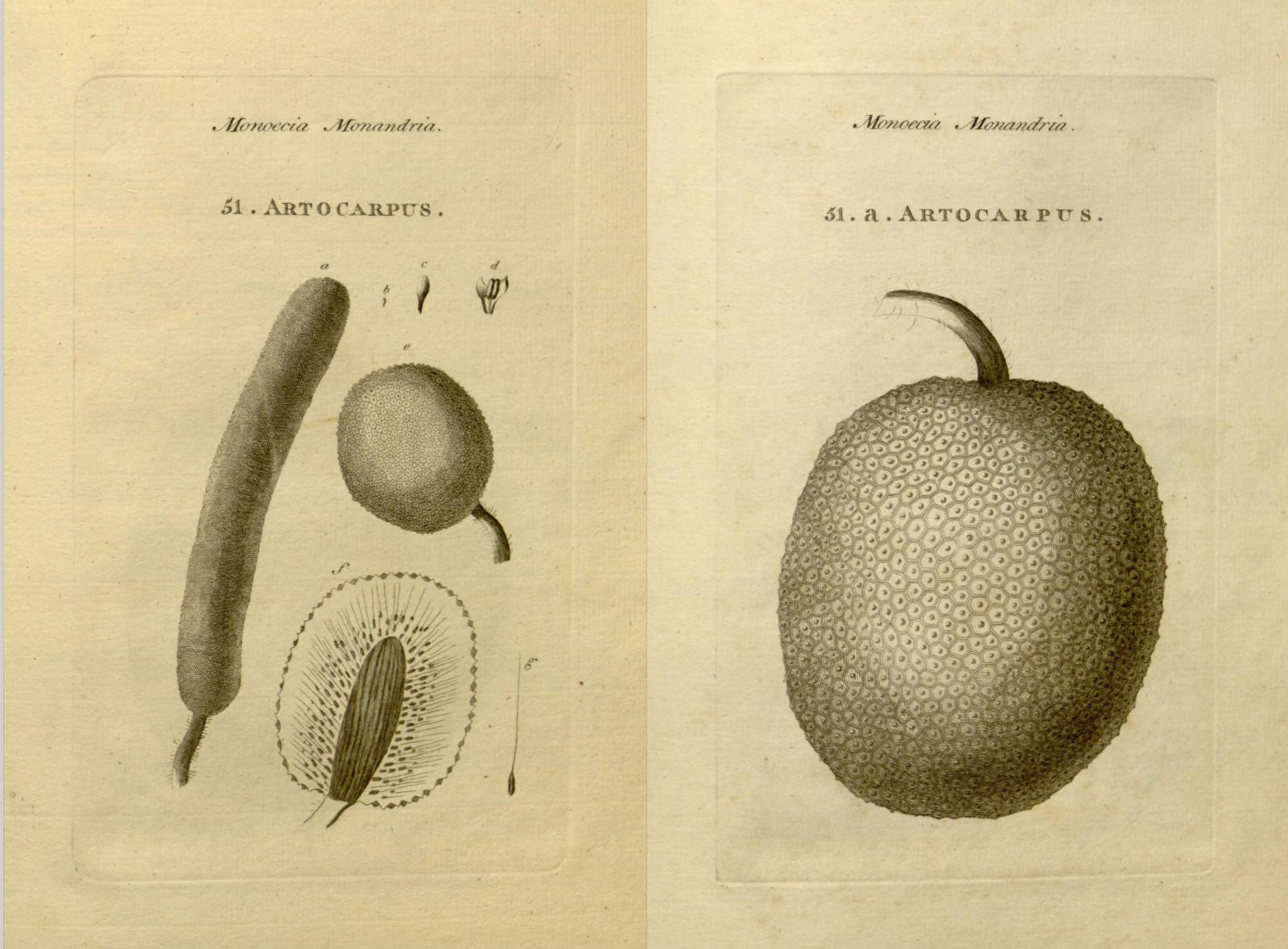
From
A Sea of Islands
George Forster’s breadfruit botany and the history of Polynesian migration.
By Andrea Wulf
“I would be far more useful to the world if I were to embark on another great voyage,” the German naturalist George Forster told a friend in November 1783. Weren’t there enough people who could sort, classify and regurgitate what had already been discovered? But if he couldn’t travel to distant continents and islands, he could explore them with his mind and imagination—and in Kassel in early 1784 he published his groundbreaking About the Breadfruit. In what was ostensibly a botanical treatise, he illustrated how the tendrils of botany reached into culture, ethnography, history, linguistics and human migration. A brilliant and original piece of scholarship, About the Breadfruit reveals Forster’s visionary thinking, the work of a man way ahead of his time.
Forster had first encountered the breadfruit a decade before, while traveling as an assistant to his father, the naturalist Johann Reinhold Forster, aboard the HMS Resolution, during Cook’s second voyage. It was a tropical fruit that grew on large trees on many of the South Pacific islands they had visited. He had enjoyed the dishes made with the abundant breadfruit—roasted on hot stones or fermented into a dough that was baked like bread—but he had also noticed that they had been seedless. With no seeds, the breadfruit trees on Tahiti, Tonga, Tanna, and Malakula (as he explained in his essay), could only be propagated by cuttings from suckers that grow off the tree’s roots. During the many months they had spent in the region, Forster had not seen a single wild breadfruit tree—all of them had been planted by humans.
That made him wonder where breadfruit trees originated and how they had arrived on the islands.
Read the rest of “A Sea of Islands,” an excerpt from The Traveler: One Man’s Quest for Humanity from the South Seas to Revolutionary Paris.
CONTRIBUTOR
Andrea Wulf is an award-winning writer of eight books, including The Invention of Nature and Founding Gardeners, which were both on the New York Times Best Seller List. Her books have been translated into 27 languages. The Invention of Nature has won 15 international awards, including the Royal Society Science Book Award. Her latest book is The Traveler: One Man’s Quest for Humanity from the South Seas to Revolutionary Paris.
APROPOS
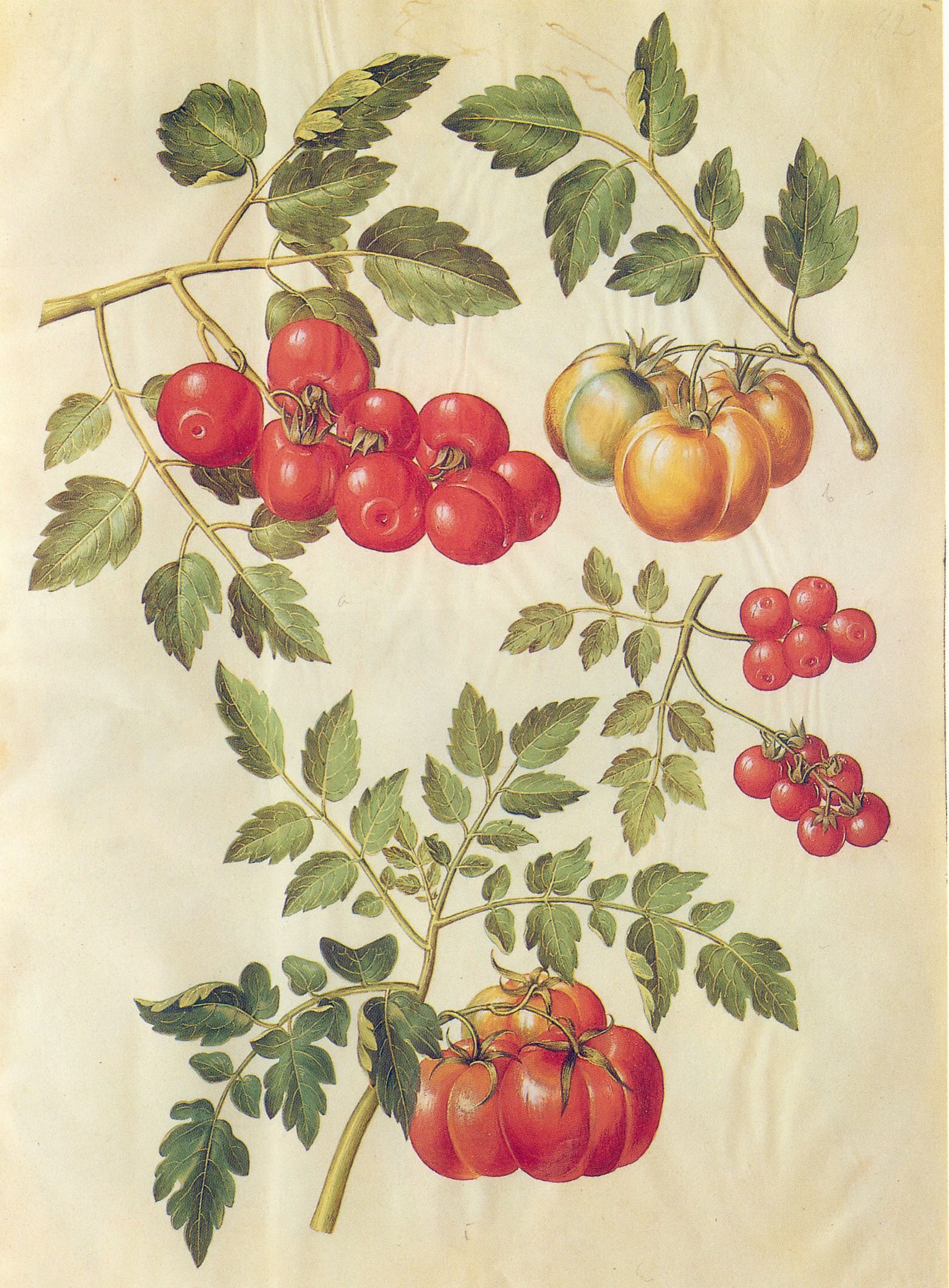

From Horace Gray’s opinion in Nix v. Hedden. Produce importer John Nix and his four sons hoped to avoid a 10 percent tax on their Caribbean tomatoes under the Tariff of 1883, an act signed into law by Chester A. Arthur that exempted fruit. Though the decision would seem to legally preclude them from doing so, Tennessee, Ohio, Arkansas, and Louisiana have since named tomato varieties their state fruit. In 2016 the Michelin-starred vegetarian restaurant Nix, named for the decision, opened in New York City.
This was an action brought February 4, 1887, against the collector of the port of New York to recover back duties paid under protest on tomatoes imported by the plaintiff from the West Indies in the spring of 1886, which the collector assessed under “Schedule G. Provisions” of the tariff act of March 3, 1883, imposing a duty on “vegetables in their natural state, or in salt or brine, not specially enumerated or provided for in this act, 10 percent ad valorem” and which the plaintiffs contended came within the clause in the free list of the same act: “Fruits, green, ripe, or dried, not specially enumerated or provided for in this act.”
The single question in this case is whether tomatoes, considered as provisions, are to be classed as vegetables or as fruit within the meaning of the tariff act of 1883.
The only witnesses called at the trial testified that neither vegetables nor fruit had any special meaning in trade or commerce different from that given in the dictionaries, and that they had the same meaning in trade today that they had in March 1883.
The passages cited from the dictionaries define the word fruit as the seed of plants, or that part of plants which contains the seed, and especially the juicy, pulpy products of certain plants, covering and containing the seed. These definitions have no tendency to show that tomatoes are “fruit,” as distinguished from “vegetables,” in common speech, or within the meaning of the tariff act. There being no evidence that the words fruit and vegetables have acquired any special meaning in trade or commerce, they must receive their ordinary meaning. Of that meaning the court is bound to take judicial notice, as it does in regard to all words in our own tongue; and upon such a question dictionaries are admitted not as evidence but only as aids to the memory and understanding of the court.
Botanically speaking, tomatoes are the fruit of a vine, just as are cucumbers, squashes, beans, and peas. But in the common language of the people, whether sellers or consumers of provisions, all these are vegetables which are grown in kitchen gardens, and which, whether eaten cooked or raw, are, like potatoes, carrots, parsnips, turnips, beets, cauliflower, cabbage, celery, and lettuce, usually served at dinner in, with, or after the soup, fish, or meats which constitute the principal part of the repast, and not, like fruits generally, as dessert.
The attempt to class tomatoes as fruit is not unlike a recent attempt to class beans as seeds, of which Mr. Justice Bradley, speaking for this court, said, “We do not see why they should be classified as seeds, any more than walnuts should be so classified. Both are seeds, in the language of botany or natural history, but not in commerce nor in common parlance. On the other hand, in speaking generally of provisions, beans may well be included under the term vegetables. As an article of food on our tables, whether baked or boiled, or forming the basis of soup, they are used as a vegetable, as well when ripe as when green. This is the principal use to which they are put. Beyond the common knowledge which we have on this subject, very little evidence is necessary, or can be produced.” Judgment affirmed.
First published in the Spring 2018 issue, Rule of Law.
Moreover, on the shores of the rivers there are willows on which white bread grows in abundance, and the rivers beneath these trees flow with sweet milk. The white bread constantly falls into their currents, so that all may eat to their hearts’ content.
_pl_7167_(1891).jpg)
From
The Marriage of Vanilla
In 1841 twelve-year-old slave Edmond Albius invented the technique that made the vanilla industry possible.
By Sarah Lohman
Cultivating vanilla is an intricate and laborious process from start to finish. That’s the reason it’s the second most expensive spice in the world, right after saffron.
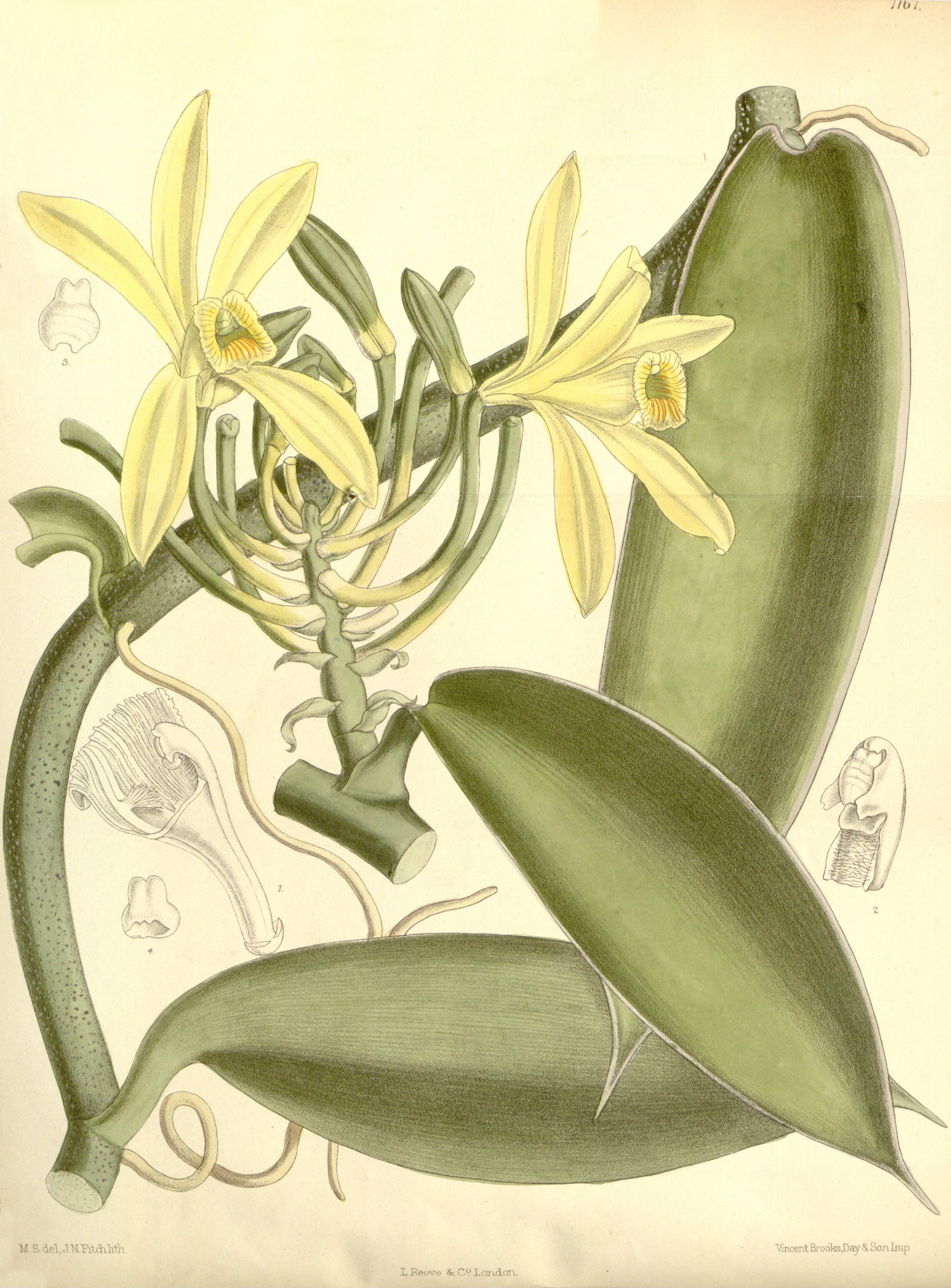
All the vanilla orchids bloom in the month of March, with pale yellow, white, or green blossoms that smell faintly spicy, like cinnamon. The flowers only last a few hours, opening in the morning and shriveling by noon. Although vanilla orchids contain both male parts (the anther, which creates pollen) and female parts (the stigma, which receives pollen), these organs are separated by a thin membrane that seems to prevent the plant from self-pollinating. Botanists believe the plant is pollinated by native animals but are uncertain which ones. For many years, a tiny insect known as the Melipona bee was thought to be the flower’s pollinator. But recent research—performed by a team of graduate students who sat on platforms in the jungle canopy to watch wild vanilla orchids bloom—saw many different types of bees, ants, hummingbirds and bats visit the flowers. But none of them showed signs of pollinating. In all likelihood, it might be several of these visitors that guarantee the plant’s fertilization.
In the nineteenth century, when the plant was taken outside of Mexico, it lacked the native pollinators necessary for natural fertilization. It was a Belgian botanist named Charles Morren, working with a greenhouse specimen, who first made this link in 1839. He noted “the absence of the species of insect which nature has doubtless given to the climate of Mexico to effect in this latter region a fecundation.” To fertilize a vanilla plant, he wrote, you needed to do it by hand: “It is thus necessary to raise the velamen or to cut it when the plant is to be fecundated, and to place in direct contact the pollen and the stigmatic surface.” He went on to note: “The fecundation never fails.”
If you’re confused by Morren’s instructions, don’t worry, you’re not the only one. The single line he wrote about this extremely delicate process baffled botanists around the world. When they attempted to follow his instructions, they had spotty results at best. It’s actually not Morren’s method that’s used to hand-pollinate vanilla today. We use the method of the unlikely hero of nineteenth-century botany, Edmond Albius.
Read the rest of “The Marriage of Vanilla,” originally published in 2017.
CONTRIBUTOR
Sarah Lohman is a culinary historian and author of the blog Four Pounds Flour. Her first book, Eight Flavors: The Untold Story of American Cuisine, was published by Simon & Schuster in December 2016.
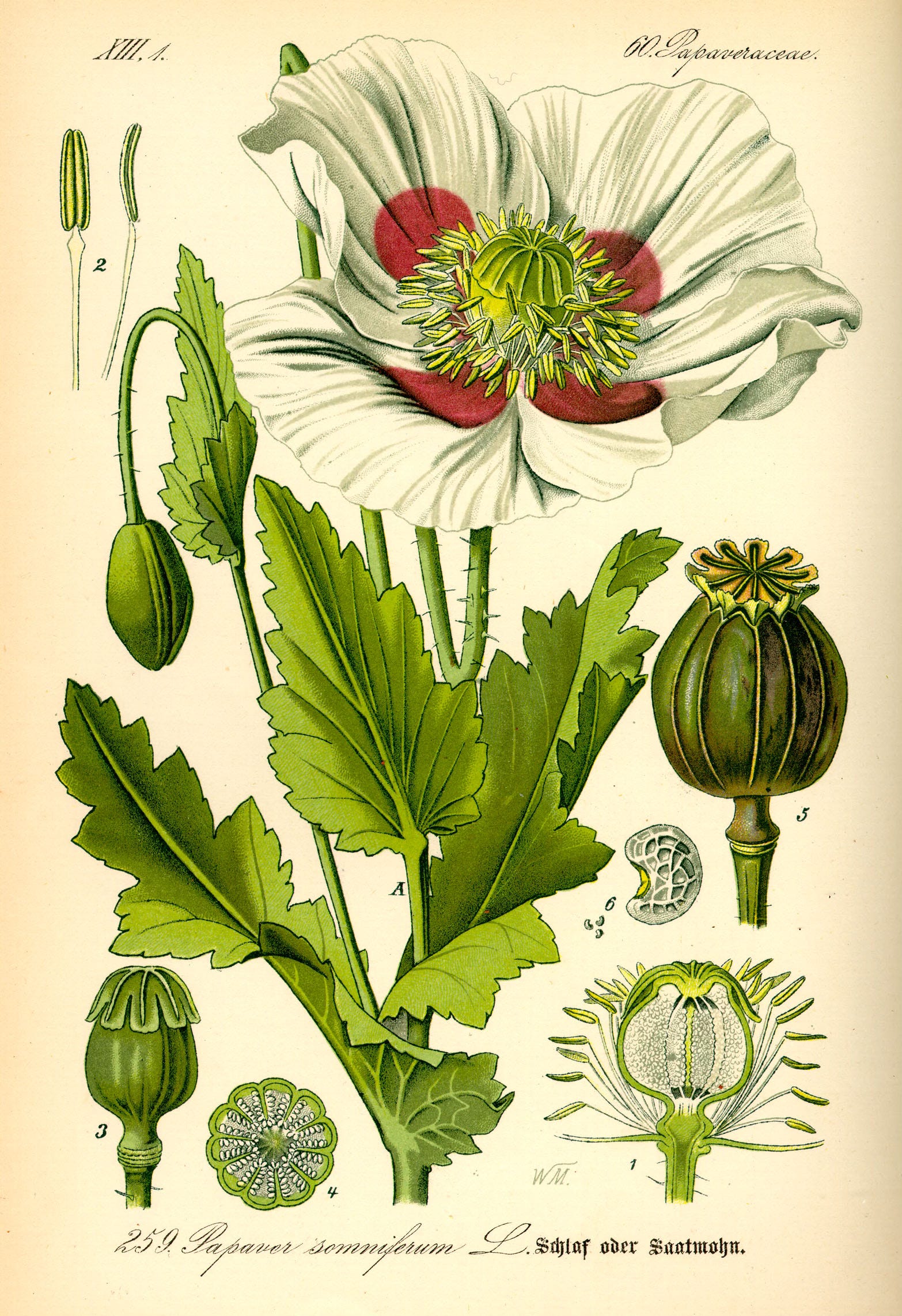

Last season was a strange one in my garden, notable not only for the unseasonably cool and wet weather—the talk of gardeners all over New England—but also for its climate of paranoia. One flower was the cause: a tall, breathtaking poppy, with silky scarlet petals and a black heart, the growing of which, I discovered rather too late, is a felony under state and federal law. Actually it’s not quite as simple as that. My poppies were, or became, felonious; another gardener’s might or might not be. The legality of growing opium poppies (whose seeds are sold under many names, including the breadseed poppy, Papaver paeoniflorum, and, most significantly, Papaver somniferum) is a tangled issue, turning on questions of nomenclature and epistemology that it took me the better part of the summer to sort out.
It started out if not quite innocently, then legally enough. Or at least that’s what I thought back in February, when I added a couple of poppy varieties (P. somniferum as well as P. paeoniflorum and P. rhoeas) to my annual order of flowers and vegetables from the seed catalogs. But the state of popular (and even expert) knowledge about poppies is confused, to say the least; mis- and even disinformation is rife. I’d read in Martha Stewart Living that “contrary to general belief, there is no federal law against growing P. somniferum.” Before planting, I consulted my Taylor’s Guide to Annuals, a generally reliable reference that did allude to the fact that “the juice of the unripe pod yields opium, the production of which is illegal in the United States.” But Taylor’s said nothing worrisome about the plants themselves. I figured that if the seeds could be sold legally (and I found somniferum on offer in a half-dozen well-known catalogs, though it was not always sold under that name), how could the obvious next step—i.e., planting the seeds according to the directions on the packet—possibly be a federal offense? Were this the case, you would think there’d at least be a disclaimer in the catalogs.
Read the rest of “Bleeding a Poppy,” from the Winter 2012 issue, Intoxication.
CONTRIBUTOR
From “Opium Made Easy.” Once writing that he plants “certain things because I want to learn certain things,” Pollan published A Place of My Own: The Education of an Amateur Builder in 1997, The Botany of Desire: A Plant’s-Eye View of the World in 2001, and The Omnivore’s Dilemma: A Natural History of Four Meals in 2006. His most recent book is A World Appears: A Journey into Consciousness.
Lapham’s Quarterly and the Lapham’s Quarterly Substack are projects of the American Agora Foundation, which is dedicated to fostering an appreciation of, and acquaintance with, the uses and value of history. You can find information about the Quarterly’s ongoing revival here.