

Voices: In Memoriam
In memory of Gordon S. Wood (1933–2026), Mike Wallace (1942–2026), and Carlo Ginzburg (1939–2026). Also: Michael Pollan on what novelists can teach neuroscientists about consciousness.

First, on June 7, came the news that the American historian Gordon S. Wood had died at age 92. On June 17, the obituaries for Italian historian Carlo Ginzburg began to appear. And two days ago, on July 5, we lost the great historical chronicler of New York City, Mike Wallace. We had planned to devote this installment of Voices to readings on consciousness. Instead, in tribute, we are sharing the voices of these three late historians, compiling three selections, one from the essay by Gordon S. Wood that we published on the Lapham’s Quarterly website last Friday, July 3; another from the essay by Mike Wallace, “Art of This Century,” that we published last October. We hope to bring an essay by Carlo Ginzburg to Lapham’s Quarterly soon, but in the meantime, we are excerpting here a transcribed interview with Ginzburg published by the Italian journal eSamizdat and brought to our attention by Arendt scholar Samantha Rose Hill. We also recommend the interview with Ginzburg published in June by our friends at The Point. We conclude this installment of Voices with one selection on consciousness, from Michael Pollan’s “An Ordinary Mind on an Ordinary Day.”
From
“As Though They Were Blood of the Blood”
Jefferson’s Declaration and the problem of American identity.
by Gordon S. Wood
To be an American is not to be someone, but to believe in something. And the something that Americans most readily believe in can be found in the Declaration of Independence. By itself it makes the United States a nation.
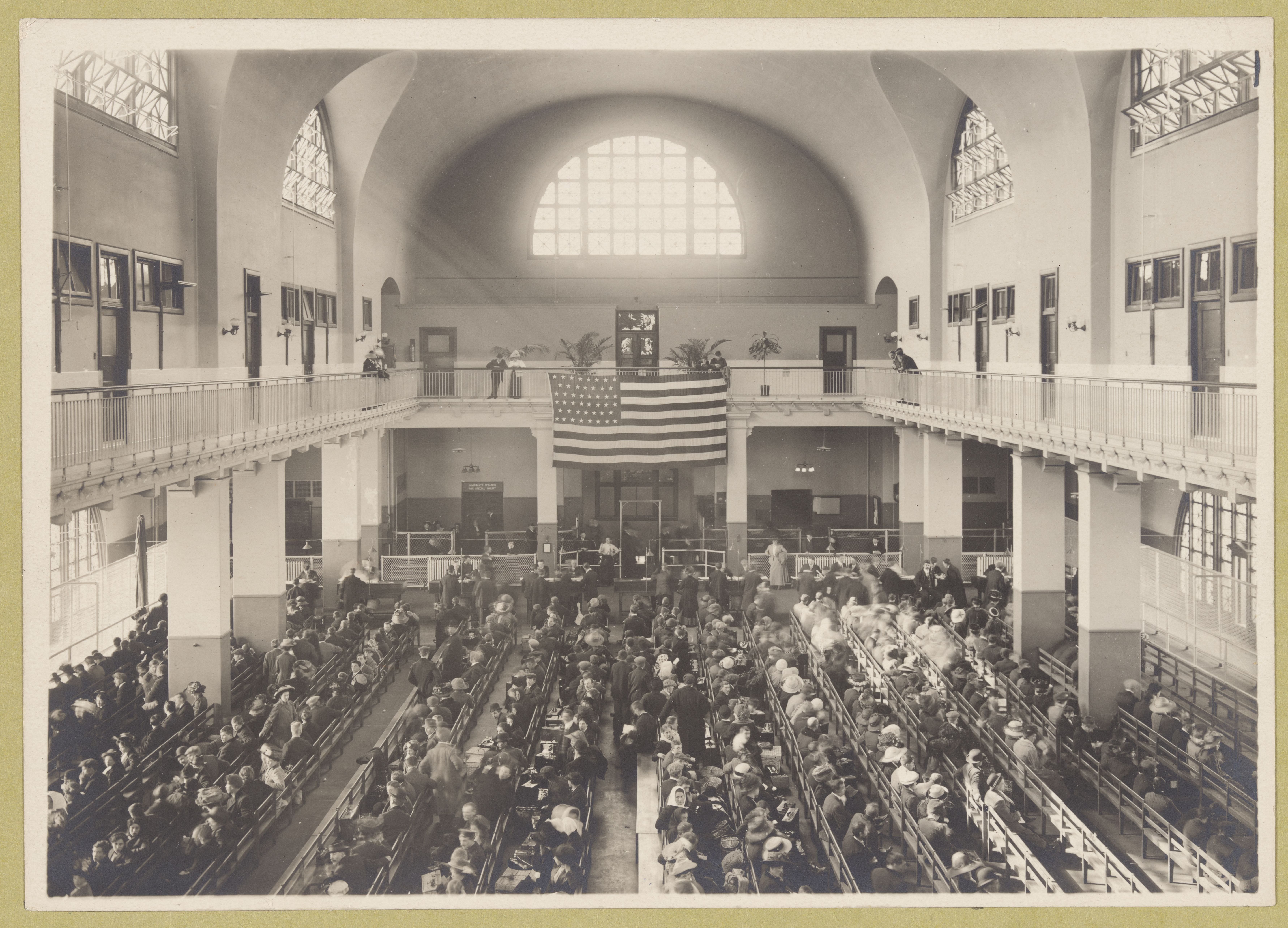
The U.S. has not been a nation in any traditional meaning of the term, that is, a political body composed of a people with common ancestry or cultural heritage. There is no American ethnicity that corresponds to the state called the United States, and there was no such distinctive ethnicity even in 1776 when the U.S. was created. Although the first sentence of the Declaration of Independence holds out the promise of Americans becoming “one people,” at the end of the text the members of the Continental Congress could only mutually pledge “to each other” their lives, their fortunes, and their sacred honor. There was nothing else but themselves they could dedicate themselves to—no patria, no fatherland, no nation as yet.
Even at the time of the founding America already had a diverse society. In addition to seven hundred thousand people of African descent and tens of thousands of native Indians, nearly all the peoples of Western Europe were represented in the country. In the census of 1790 only sixty percent of the white population of well over three million could claim English ancestry. The rest were composed of a variety of ethnicities—Germans, Scots, Irish, Scotch-Irish, Dutch, and several others.
For eighteenth-century enlightened reformers, ethnic diversity and multiculturalism were not good things. The revolutionary leaders’ idea of a modern nation, shared by enlightened British, French, and German eighteenth-century thinkers as well, was one that, as David Ramsay said, was composed of “a homogeneous people,” a society that was not broken up by differences of dialects, ethnicity, religion, and local customs.
Thus many of the revolutionary leaders were desperate to think of themselves as a homogeneous people. John Jay lived in New York, the most diverse city in the country, and was himself three-eighths French and five-eighths Dutch with no English ancestry whatsoever. Nevertheless, in Federalist No. 2 Jay had the nerve to declare that “Providence has been pleased to give this one connected country to one united people—a people descended from the same ancestors, speaking the same language, professing the same religion, attached to the same principles of government, and very similar in their manners and customs.”
Jay’s statement was based on hope, not reality. Many other revolutionary leaders had little of his confidence in America’s homogeneity and instead wondered whether America could ever be a real, honest-to-goodness nation. John Adams certainly had his doubts. In America, he said, there was nothing like “the patria of the Romans, the Fatherland of the Dutch, or the Patrie of the French.” All he could see was an appalling diversity of religious denominations and ethnicities. At one point he counted at least twenty different religious sects in the U.S. “We are such a Hotch potch of people,” he concluded, “such an omnium gatherum of English, Irish, German, Dutch, Swedes, French, etc. that it is difficult to give a name to the country, characteristic of the people.”
In the aftermath of the War of 1812, the rematch with Great Britain that some Americans called the second War of Independence, Secretary of the Treasury Albert Gallatin, himself a Swiss immigrant, thought that the people had become “more American; they feel and act more as a nation; and I hope that the permanency of the Union is thereby better secured.” The war had the effect of diminishing the country’s sense of being English. The war tied Englishness exclusively to a Federalist Party that was on its last legs and about to disappear.
Yet immigration from Europe continued, and the country was even more ethnically diverse and farther away than ever from being a traditional nation.
Read the rest of “As Though They Were Blood of the Blood.”
CONTRIBUTOR
Gordon S. Wood (1933-2026) was the author of many books about revolutionary America, including The Creation of the American Republic, 1776–1787, which won the Bancroft Prize and the John H. Dunning Prize of the American Historical Association; The Radicalism of the American Revolution, which won the Pulitzer Prize for History and the Ralph Waldo Emerson Prize; The American Revolution: A History; The Americanization of Benjamin Franklin; Revolutionary Characters: What Made the Founders Different, which was a New York Times bestseller; Empire of Liberty: A History of the Early Republic, 1789–1815, which was a finalist for the Pulitzer Prize; and Friends Divided: John Adams and Thomas Jefferson, which he discussed with Lewis H. Lapham on the December 8, 2017, episode of The World in Time.
In May 1943, Peggy Guggenheim hosted a “Spring Salon for Young Artists” at the Art of This Century Gallery on West 57th Street. Guggenheim, who had inherited a modest portion of her family’s mining fortune, had opened an art gallery in London in 1938. With the aid of advisers like Marcel Duchamp, it had been asuccès d’estime, and she decided to establish a museum of contemporary art. In August 1939, Guggenheim set out for Paris to arrange loans for an opening exhibit. With the outbreak of war in September she abandoned the project and shifted into full-scale collecting mode, buying paintings and sculptures at a great clip from the likes of Picasso, Ernst, Magritte, Brancusi, Giacometti, Dalí, Kandinsky, Mondrian, Tanguy, and Chagall (some of whom sold at fire-sale prices to raise cash to leave the country).
When the Nazis approached Paris in 1940, she fled south with her collection and spent the next year in Vichy France. In Marseille, she struck up an affair with Max Ernst. She also aided Varian Fry’s smuggling of artists and intellectuals out of France and herself underwrote the flight of a small group—including Ernst—that departed Lisbon by flying boat and arrived at New York’s Marine Air Terminal on July 14, 1941. Ernst, a German national, was detained on Ellis Island but was liberated through her efforts and those of Alfred Barr, director of the Museum of Modern Art.
Guggenheim moved into a huge townhouse at 440 East 51st Street, just off Beekman Place overlooking the East River (the neighborhood reminded her of Paris), and installed Ernst therein. She offered him board (and bed), provided him a studio, and chauffeured him around town, but he refused to wed. Until Pearl Harbor made him an enemy alien—a status, Guggenheim pointed out, that included the possibility of being sent to an internment camp. Three weeks later, he deigned to submit to marriage.
It wouldn’t last long. Still, in the meantime, the couple’s elegant establishment became the center of a swirl of some of the greatest artists of Europe, dozens of whom had made their way to Gotham. (As Yehudi Menuhin noted: “One of the great war aims is to get to New York.”) André Breton, surrealist chieftain, was in her inner circle; indeed, she had paid for his escape from France and guaranteed him a $200-a-month stipend for his first year. In return, Breton helped catalog her massive art collection, which she’d had shipped across the Atlantic, labeled as “household goods.” Breton reconstituted his court around Guggenheim’s townhouse, and the surrealists were liberally represented at the lavish parties she threw. More generally, the presence of Chagall, Mondrian, Tanguy, Ernst, Léger, Lipchitz, Breton, and Duchamp, among many others, made it possible for New York to claim that it had—at least temporarily—supplanted Paris as capital of the art world.
The émigrés—fourteen of whom Pierre Matisse (Henri’s son) collectively fêted in a glittering “Artists in Exile” show at his 57th Street gallery in March 1942—for the most part did well in New York. They had important spokespersons there, access to the press, connections to private collectors, and relations (in some cases of long standing) with art dealers who exhibited and sold their work. Surrealist champion Julien Levy, Ernst’s representative, kept him in the public eye. Pierre Matisse, who looked after Chagall, gave him a monthly allowance of $350, rising to $700, and arranged for major showings (despite Chagall’s having raised J. Edgar Hoover’s hackles by his cozy relations with the Yiddish Communists around Morgyn Frayhayt).
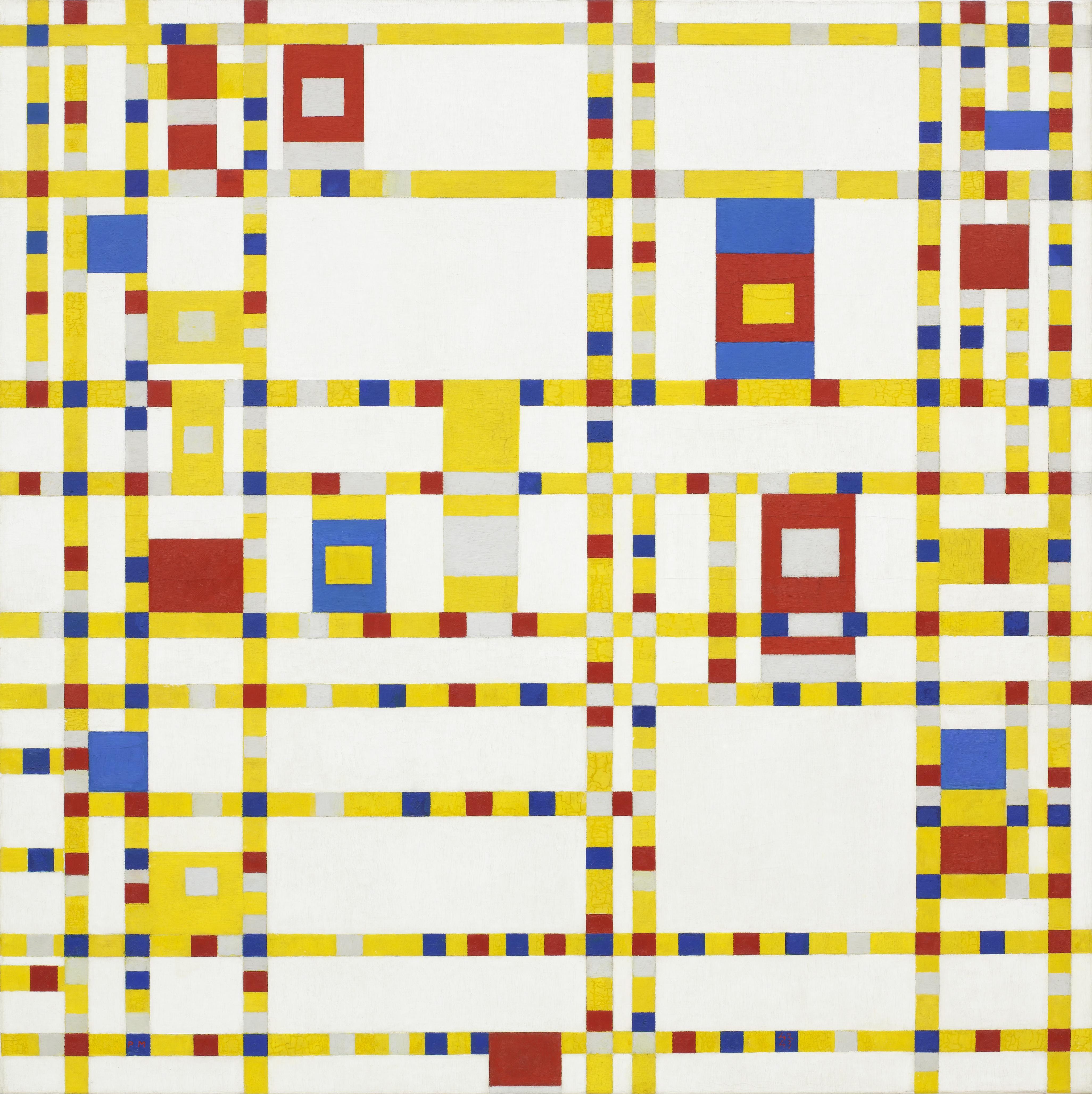
Perhaps no one was as creatively energized by the wartime city as Piet Mondrian. The Dutch artist, who arrived in September 1940 at the age of sixty-eight, fell immediately in love with New York’s architecture and flashing neon, its jazz clubs and dance halls. He was particularly fond of barrelhouse pianists Meade Lux Lewis and Albert Ammons, whose propulsive music he heard downtown at Café Society. They inspired (as did galvanic Gotham itself) dynamic new works like Broadway Boogie-Woogie (1942–43), whose buoyant network of interwoven strips pulsing with primary colors suggested an aerial view of Manhattan’s rush-hour traffic a-honk with yellow taxis. An ardent abstractionist who sought (as did Claude Lévi-Strauss) to discern universal structures beneath the buzzing confusion of surface appearances, Mondrian was enthralled by New York’s grid, that underlying matrix which channeled random urban phenomena into orderly circulatory patterns.
Mondrian and Breton represented opposite ends of the modern-art spectrum—the abstract and the surreal—but in New York, these European differences seemed less compelling. Guggenheim actively worked to reconcile prior aesthetic conflicts, wearing one earring by Tanguy and one by Calder, “in order,” she said, “to show my impartiality between surrealist and abstract art.” More importantly, her new Art of This Century Gallery adopted a similarly catholic approach. For her initial exhibition, she culled from her collection 171 works by artists of every major twentieth-century tendency. She was aided in this by experts like Duchamp, Barr, James Johnson Sweeney (director of MOMA’s Department of Painting and Sculpture), and Howard Putzel (the critic, collector, and gallery owner who had been one of her closest advisers since 1938). The result was a spectacular show that celebrated the rescue of Europe’s avant-garde culture and proposed, implicitly, the suitability of New York as its possible new home. The ATC’s launch was made even more spectacular by Guggenheim’s hiring of Frederick Kiesler, an innovative Viennese architect, to transform her seventh-floor loft into an exhibit space that upended traditional ways of presenting and appreciating art. Works were shown unframed,or supported by suspension columns, or mounted on sawn-off baseball bats protruding from curved gum-wood walls, or (like seven paintings by Paul Klee) placed on a wheel that revolved when a visitor tripped a light beam. Gotham had never seen anything like it.
More daring still, in the spring of 1943, Guggenheim expanded her embrace to include local New York artists who had been largely dismissed as uninteresting provincials by the snooty Surrealists. In part this was because she had recently quarreled with Breton and been ditched by Ernst for a young painter. She was also urged in this direction by her New York advisers Putzel and Sweeney, and by the now-resident Chilean painter Roberto Matta Echaurren. In April 1943, accordingly, she announced that her gallery would hold a competitive salon in May for American artists under the age of thirty-five. Crowds of them showed up at 57th Street carrying canvases they hoped would be considered by a jury that consisted of Guggenheim’s New York experts and two Europeans, Duchamp and Mondrian.
On judgment day, Mondrian was the first to arrive, and the elegantly attired Dutchman began perambulating the paintings. At one point he stopped walking and began staring at a particular work. Guggenheim wandered over. “Pretty awful, isn’t it?” she asked. “That’s not painting, is it?” Mondrian did not respond. She walked away. Twenty minutes later she returned to find him still rooted before the same painting, his right hand thoughtfully stroking his chin. Guggenheim again distanced herself from the work and the artist. “There is absolutely no discipline at all,” she complained. “This young man has serious problems, and painting is one of them. I don’t think he’s going to be included, and that is embarrassing because Putzel and Matta think very highly of him.”
Finally, the mesmerized Mondrian responded: “Peggy,” he said, “I have a feeling that this may be the most exciting painting that I have seen in a long, long time, here or in Europe.” Guggenheim, astounded but nimble, turned on the proverbial dime. She raced off and began dragging other jurors over to the painting, saying: “I want you to see something very exciting. It’s by someone called Pollock.”
Jackson Pollock, a farm boy from Wyoming, had been living in New York since 1930 when he had come at the age of eighteen to study at the Art Students League with Thomas Hart Benton. He’d also (not having much money) been attracted to the free art courses offered by the Greenwich and Henry Street settlement houses. As the Depression deepened, Pollock, unable to make ends meet, was rescued, like many other floundering artists, by a governmental lifeline. In early 1935 he was hired by the Parks Department to restore civic monuments (he scoured, among others, the Firemen’s Memorial at Riverside Drive and West 100th Street and the equestrian Washington in Union Square). Later that year he was taken on board by the Works Progress Administration’s Federal Art Project as a mural assistant, a regularly salaried position that, with occasional interregnums, would provide him with economic security for most of the next seven years.
During this period Pollock soaked up the host of artistic influences then to be found in the cornucopian metropolis. He was captivated by the Mexican muralists. In 1930 Pollock had met José Clemente Orozco while working on murals for the New School cafeteria at 66 West 12th Street (and in 1936 he would travel up to Dartmouth College to see the Orozcos there). In 1933 he watched Diego Rivera paint his doomed mural at Rockefeller Center.
In 1936 Pollock joined the Experimental Workshop—billed as “A Laboratory of Modern Techniques in Art”—that David Alfaro Siqueiros set up in his huge loft at 5 West 14th Street; members worked with new industrial materials like Duco (a synthetic resin paint developed for automobiles), pouring it onto panels laid out on the floor, or using sticks to splatter and drip it on the surface below.
He visited all the great MOMA exhibitions—“Cubism and Abstract Art,” “Fantastic Art, Dada, Surrealism,” and the Picasso retrospective (as well as Picasso’s Guernica at the Valentine Gallery, returning to see it repeatedly). He was fascinated, too, by MOMA’s colossal “Twenty Centuries of Mexican Art” exhibition of 1940, arranged with help from Nelson Rockefeller. It featured pre-Columbian artifacts but also brought Orozco back to New York, just after the Nazis blitzkrieged France, to paint in public a portable mural called Dive Bomber and Tank, with Pollock among the onlookers. Pollock also attended the next year’s mammoth “Indian Art of the United States” exhibition, watching as Navajo artists executed sand paintings by allowing sand of various colors to trickle through their hands to the gallery floor.
Deeply taken with Native American art, Pollock immersed himself, too, in Franz Boas’ Northwest Coast collection at the American Museum of Natural History and in the Museum of the American Indian’s trove of artifacts, from whose Bronx storehouse Ernst, Lévi-Strauss, and Breton were making withdrawals. And he prowled the Midtown galleries, attending the Expressionist shows of Klee, Kandinsky, and Max Beckmann at Paul Rosenberg’s gallery; the exhibitions of Joan Miró at the Valentine and the Matisse; and the displays of Surrealists Ernst and Tanguy at Julien Levy’s.
If Pollock’s intake was rich and varied, his output, though occasionally remarkable, remained inchoate and intermittent. He engaged in self-destructive drunken binges, bar brawls, and violent outbursts during which he might carve up his own canvases; alternating these with extensive periods of depression, alcoholic stupor, and nights spent sleeping in the gutter. In 1937 he began four years of Jungian psychotherapy. The next year, at his brother’s urging, he quasi-voluntarily institutionalized himself as a charity patient at New York Hospital’s asylum in White Plains, where affluent Gotham families sent their black sheep to dry out; he resumed drinking as soon as he left. In 1941, after his latest therapist wrote his draft board suggesting Pollock be referred for a medical examination, he was found psychiatrically unfit to serve and declared 4F.
Nineteen forty-one, however, was the year his life began to turn around, thanks to making some crucial metropolitan connections. The previous year he had encountered John Graham, a painter, critic, collector, and dealer of some notoriety in New York. Descended from minor Polish nobility, Graham (né Dombrowski) had adopted Russia as his homeland, served the tsar as a cavalry officer, then fled to Gotham after the Revolution.
In the 1920s Graham took up painting, first studying under John Sloan at the Art Students League, then traveling frequently to Paris, where he became a devotee of Cubism and (so he claimed) an intimate of Picasso. His embellished autobiography, eccentric opinions, and dandyish self-presentation gave him cosmopolitan cachet among status-anxious local artists, among whom he promoted Surrealist techniques like “automatic writing.” However, what really secured Graham’s reputation was his ability to spot many of the city’s most promising young painters before others did and then promote them. He was not only the first to acclaim Pollock a genius in the rough, he acted on that assertion by including the artist in an exhibition pairing French and American painters, held at the McMillen Gallery (148 East 55th) in January 1942, hanging his work alongside that of Picasso and Matisse.
That same McMillen exhibition included another emerging New York artist, Lee Krasner, who introduced herself to Pollock, promptly fell in love with him, and proceeded to take him in hand (at considerable cost to her own career). Born Lena Krassner in 1908 to an immigrant Russian Jewish couple in East New York, Krasner had studied art at Washington Irving High School, the Woman’s Art School at Cooper Union, the Art Students League, and the National Academy of Design.
In 1926 she departed Brooklyn to begin life as an artist in Manhattan, only to be confronted, in 1929, with collapsing stock and art markets. After supporting herself for a time as a model and waitress, she was hired in 1934 by the Public Works of Art Project, and then was taken on by the Federal Art Project as a mural assistant. Shortly after she met Pollock, the FAP was reorganized as the Graphics Section of the War Services Division, and in the summer of 1942 Krasner was set to design window displays that promoted courses at city colleges; she picked Pollock as her assistant. In October she was redeployed to creating Navy recruiting posters; she hired Pollock for the team.
Krasner, far better wired into the New York art world than Pollock, also began introducing him to influential figures, starting with her teacher Hans Hofmann. A celebrated German émigré painter, who really was a friend of Picasso and Matisse, Hofmann had moved to Gotham in 1932 and in 1933 opened a school and atelier at 52 West Eighth Street at which he began transmitting to New York artists the modernist principles of Munich and Paris. Krasner then arranged visits to other members of Hofmann’s circle, which led in spring 1942 to a visit to Pollock’s studio from MOMA’s James Johnson Sweeney, followed by another that summer from Howard Putzel, and subsequently to Peggy Guggenheim’s invitation to her 1943 Spring Salon.
Read the rest of “The Art of This Century.”
CONTRIBUTOR
Mike Wallace
Mike Wallace, Distinguished Professor Emeritus of History at John Jay College of Criminal Justice, was the co-author of Gotham: A History of New York City to 1898, winner of the Pulitzer Prize for History and the author of the final two volumes in his Gotham trilogy, Greater Gotham: A History of New York City from 1898 to 1919, winner of the Ralph Waldo Emerson Award, and Gotham at War: A History of New York City from 1933 to 1945.
From
The Art of Slow Reading
A conversation with Carlo Ginzburg.
Carlo Ginzburg: The debates in The Cheese and the Worms contributed to the construction of the idea of microhistory, which actually never appeared in that book…When we talk of microhistory, it is important to understand what we mean by the prefix micro-. It does not refer to the actual or symbolic dimensions of the research subject, but to the microscope. It is clear that we can put anything under the microscope lens, be it a piece of elephant skin or the wings of a dragonfly.
eSamizdat: In fact, you have been working on widely different topics, from peasant culture to the art of Piero della Francesca.
Carlo Ginzburg: Yes, exactly. And the fact that the “Microhistories” series of books starts with a volume on Piero della Francesca should already explain this apparent contradiction. As for the issue of generalisation, I explored it further in my essay “The Bond of Shame,” which is translated in English, Japanese, and French, and it was published again in the journal New Left Review. This essay’s first claim is that our country is the one we can be ashamed of. The level of shame varies from country to country; nevertheless, shame implies a sense of belonging. I remember that I wrote this essay in Los Angeles, and my reaction to what was happening in the Guantanamo prison was horror, indignation, but not shame. However, at the same time, I was feeling ashamed of something less serious that was going on in Italy, so I wondered why I was feeling shame for it. It was not guilt, but proper shame. I thought about this and, in the end, after briefly exploring this trajectory of shame, I advanced in a short paragraph an idea, possibly not the most original, of the individual intended as the intersection of several sets. Take myself as an example—I am an element of the Homo Sapiens species, of its male half, of a group of professors born in Turin and now retired, and so on. There is also a set with just one element, that one created by my fingerprints. Now, this last set, of which I am the sole element, makes sense in some specific contexts, but for a historian, thinking about an individual means to analyse the interaction of generic and less generic sets, as well as this one-element set. I do not think this is obvious.
Download a pdf of “The Art of Slow Reading “ from eSamizdat.
From
An Ordinary Mind on an Ordinary Day
What novelists can teach neuroscientists about consciousness.
By Michael Pollan
Ask about the unconscious and most neuroscientists will acknowledge its existence, grudgingly, before going on to explain that consciousness is hard enough to study as it is, without complicating the matter by bringing in something as elusive and ill-defined as unconsciousness. Kalina Christoff Hadjiilieva, a Bulgarian-born psychologist at the University of British Columbia, is a notable exception, a self-described misfit in the field. “There is something inherently poetic in consciousness that’s evading scientists right now,” Christoff Hadjiilieva told me during one of our conversations. “Most scientists don’t value the free movement of the mind, because they don’t believe anything good can come of it. They want every effort of the mind to be rewarded, preferably with a publication.”
She recently coedited The Oxford Handbook of Spontaneous Thought, an anthology that includes an illuminating essay on the history of spontaneous thought. It describes the routines of several highly accomplished historical figures—including Darwin, Beethoven, Dali, and Chandler—who achieved great success despite working a relatively short day (four to five hours) followed by lots of long walks, afternoon naps, loads of unstructured time, and long vacations. It is often not until we leave our desks to wander, whether in mind or body or both, that inspiration strikes.
We moderns tend to attribute the thoughts that arrive unbidden, from “out of the blue,” to somewhere within us, like the unconscious, but in the past, people believed they came from outside us—inspirations from the Muses or the gods. Yet even now, these spontaneous insights or intuitions possess an aura and an authority that ideas delivered by reasoning seldom command. We imbue them with a residue of magic, perhaps because their origin remains something of a mystery.
A devoted novel-reader since her teens, Christoff Hadjiilieva suspects that artists—who “live their thoughts”—may know more about the stream of consciousness than her fellow scientists do.
“Catching one’s thoughts as they arise is a lot more difficult than it sounds,” she said. “I suspect that fiction writers develop the ability to watch their own thoughts arising in the course of writing.”
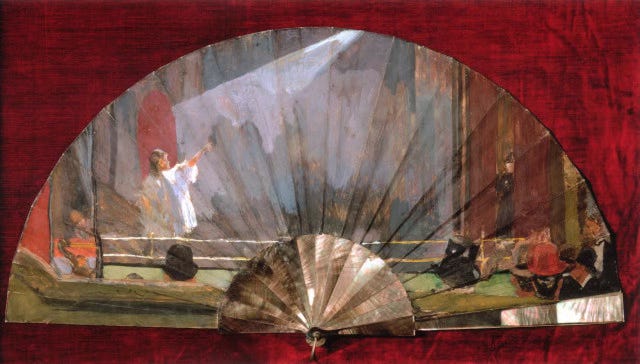

As an English major in college, I had read (or at least been assigned) a handful of stream-of-consciousness novels, and I began to wonder what they might have to teach me now. At the time, I found reading novelists like James Joyce and Virginia Woolf difficult and, to be honest, boring. Not much ever happened. Strolling a few short blocks through Dublin or London could take fifty pages, most of them consisting of fragments of interior monologue, sometimes impossible to piece together. But now, as a student of the stream, I look to these works for wonderful case studies: Spontaneous Thought 101. Here’s how Woolf spelled out her ambition for the English novel in a 1925 essay in The Common Reader:
Examine for a moment an ordinary mind on an ordinary day. The mind receives a myriad impressions—trivial, fantastic, evanescent, or engraved with the sharpness of steel. From all sides they come, an incessant shower of innumerable atoms; and as they fall…they shape themselves into the life of Monday or Tuesday…Let us record the atoms as they fall upon the mind in the order in which they fall, let us trace the pattern, however disconnected and incoherent in appearance, which each sight or incident scores upon the consciousness.
Of course, Woolf and Joyce and the other modernists did not “discover” consciousness; novelists have been writing about it since at least the birth of the novel. It’s pretty much what novels do—take us into the minds of characters to satisfy our deep human curiosity to find out what, but also how, other people think. We probably know more about Emma Bovary’s thinking than we do any person in our world, perhaps even ourselves.
Read the rest of “An Ordinary Mind on an Ordinary Day.”
CONTRIBUTOR
Michael Pollan
Michael Pollan began writing and publishing essays and literary journalism at Harper’s Magazine, where he served as executive editor under Lewis H. Lapham from 1984 to 1994. He is the author of ten books, including This Is Your Mind on Plants, How to Change Your Mind, Cooked, Food Rules, In Defense of Food, The Omnivore’s Dilemma, and The Botany of Desire, all of which were New York Times bestsellers. A Guggenheim and Radcliffe fellow, Pollan has taught writing at the University of California and at Harvard University. In 2010, Time named him one of the one hundred most influential people in the world.